Make India's water and energy observable.
Two years, two missions: real-time water quality for the Jal Jeevan Mission, and energy models that could tell identical machines apart.
Water
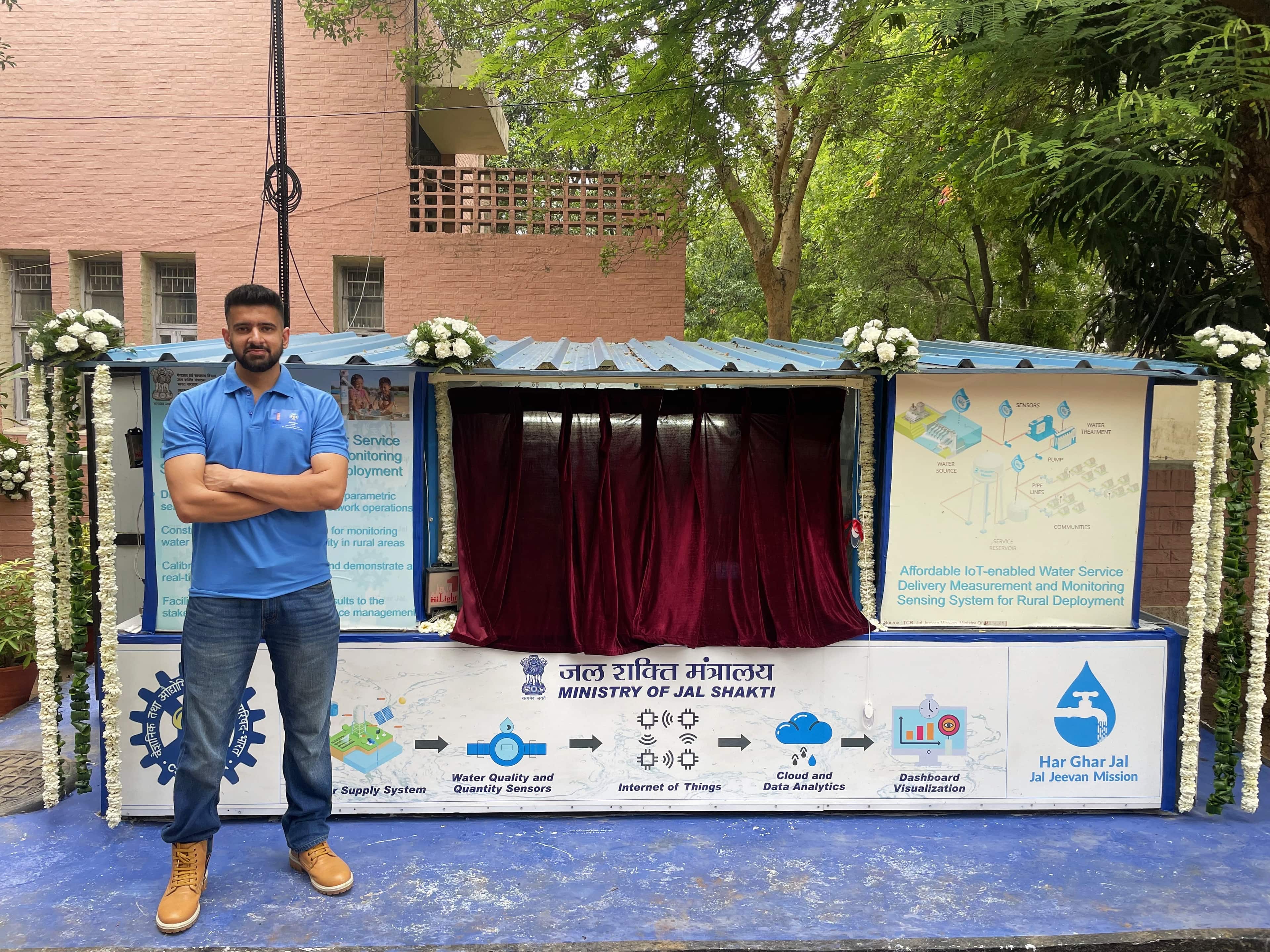
The Jal Jeevan Mission is India's push to bring tap water to every rural household. Under it, I worked with Dr. Babban Kumar's team on a question that sounds simple and isn't: how do you know the water reaching a home is safe, right now? We planned and set up the first IoT-enabled water-quality monitoring station in the tricity, streaming pH, turbidity, conductivity and TDS in real time, as a pilot the rest of the country could follow. I wrote the detailed project reports that took it to state governments.
Then came the audit of Punjab's water: twenty samples from every district, hundreds of samples in total, all to be processed within a month. External labs quoted weeks, and water samples don't wait. After a day, the water loses its properties and the test is worthless. So we stopped outsourcing and set up our own lab. I'm a computer science graduate who had honestly forgotten how to do a titration. I relearned. We collected, tested and analyzed every sample ourselves, and finished inside the month.
That dataset became a peer-reviewed paper in a Springer journal on groundwater quality monitoring.
Energy
A year in, I moved to the energy department to work on Non-Intrusive Load Monitoring with Dr. Mukesh Kumar. NILM is the science of reading a building's entire electrical life from a single measurement point. We built e-Sense, CSIO's own real-time energy tracking device.
The problem I owned sounds almost like a riddle. Take three identical air conditioners, same model, same production batch: can an algorithm tell them apart by their electrical signatures alone? Ours could, almost every time. We demonstrated it at multiple conferences.
The work was part of an Indo-German project on durable, energy-efficient, climate-resilient buildings for India. I deployed our monitoring systems in buildings in Ladakh, Roorkee and Jaipur, three brutally different climates, to see how they would hold up.
What it taught me
Two things. First, once you decide something must happen, the impossible becomes logistics. The one-month deadline only looked impossible until we owned the whole process ourselves. Second, and bigger: think in systems, not components. Sensors, algorithms, hardware constraints and human behavior only work when you understand how each piece talks to the rest. That lens is the core of how I do product work today.